Quantum Materials by Design
How can we control the properties of a material by changing the way its electrons interact with one another and with the crystal lattice?
At QSOLID, we explore this question through Quantum Spin–Orbital–Lattice Interactions by Design. We combine first-principles calculations with many-body theory to understand quantum materials and identify ways to tune their electronic and magnetic properties. Our research focuses on systems in which electron correlations, spin–orbit coupling, and lattice structure compete or cooperate to produce states that cannot be understood from a simple independent-electron picture. Our approach connects the search for promising materials with the design of their interactions and the analysis of experimentally observable properties. Insights from each stage guide the next calculation and help refine our understanding of the underlying physics.
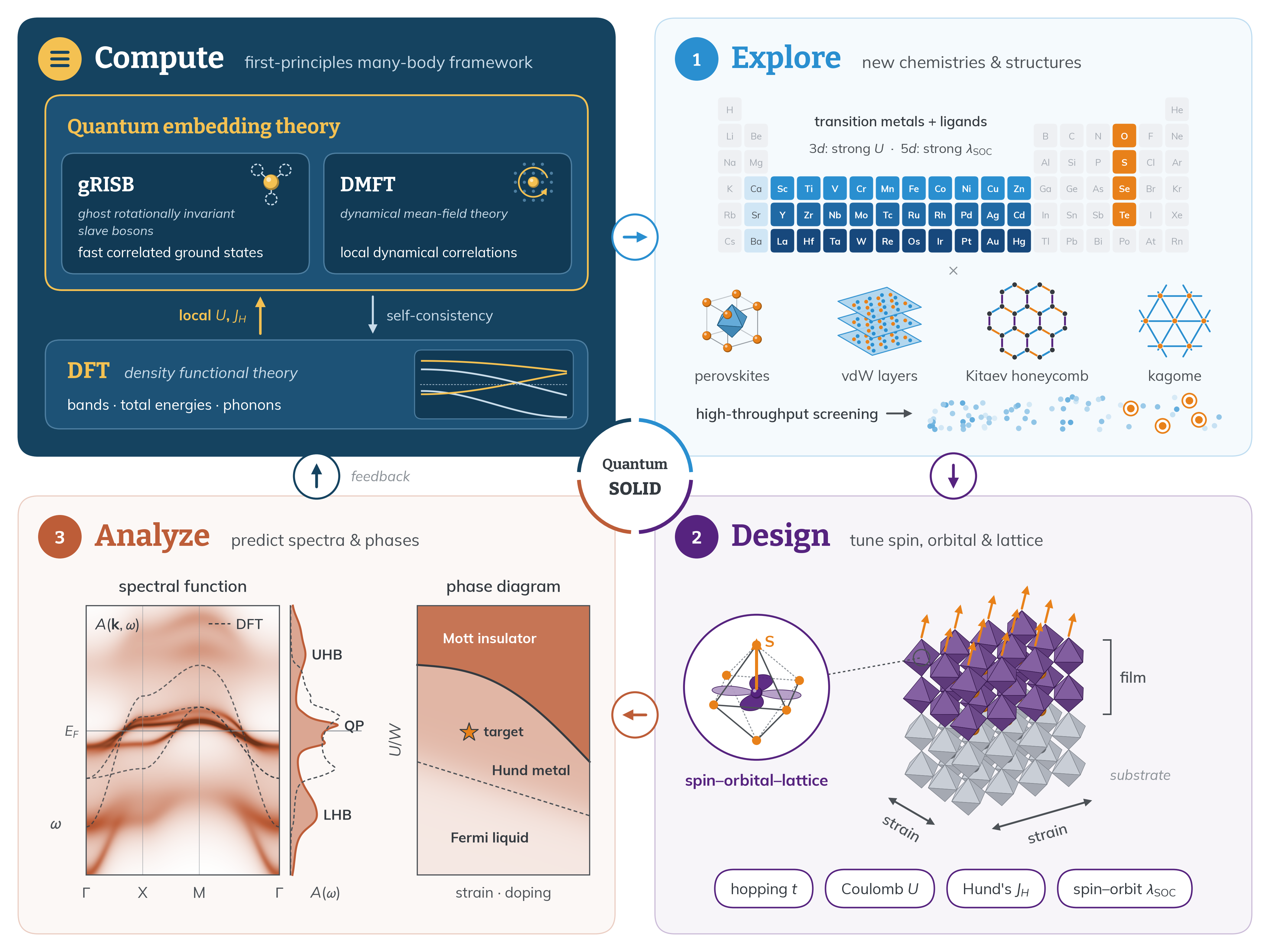
Our research framework connects computational methods, materials exploration, interaction design, and physical analysis. The spectra and phase diagram are schematic. Click the image to enlarge.
Compute: First-Principles Many-Body Theory
We develop and apply computational approaches that connect realistic crystal structures to the physics of interacting electrons. Density functional theory (DFT) provides a starting point for studying electronic bands, total energies, and lattice properties, and for constructing low-energy models of relevant electronic states. To investigate correlation effects beyond conventional band descriptions, we use dynamical mean-field theory (DMFT) and ghost rotationally invariant slave-boson theory (gRISB). DMFT treats local dynamical correlations through a self-consistent quantum impurity problem. gRISB uses an enlarged auxiliary space containing ghost degrees of freedom to describe correlated electronic states within a complementary embedding framework. Together, these approaches help us examine how interactions reshape electronic spectra, renormalize quasiparticles, and drive changes between metallic and insulating behavior.
Explore: Materials and Quantum Phases
We investigate transition-metal compounds in which chemistry and crystal structure provide opportunities to control electronic behavior. Our interests include correlated oxides, layered materials, and low-dimensional structures, with particular attention to the interplay of orbital character, electron filling, and lattice geometry. Changing the transition metal, ligand environment, or dimensionality can alter the balance between electron hopping, Coulomb repulsion, Hund’s coupling, and spin–orbit coupling. By comparing these ingredients across materials and models, we seek promising settings for unusual magnetic states, correlated metals, and topological electronic phases. This understanding also guides the selection of candidates for further theoretical and experimental study.
Design: Control of Spin, Orbital, and Lattice
Our central goal is to identify how changes in structure and environment can produce a desired electronic or magnetic response. We study how epitaxial strain, structural distortions, and heterostructure geometry modify orbital energies, bandwidths, and effective magnetic interactions. Research topics include strain-driven changes in magnetic order and spin states, orbital-selective electronic behavior, and coupling between magnetic excitations and lattice motion. We examine the mutual influence of spin, orbital, and lattice degrees of freedom to establish microscopic principles for controlling material properties.
Analyze: Spectra, Phases, and Mechanisms
We connect microscopic calculations to quantities that can be compared with experiment. Depending on the system, these include electronic dispersions and spectral functions, magnetic interactions and excitations, and lattice dynamics. Through comparisons with spectroscopy and other measurements, we investigate which interactions account for observed behavior and which changes can distinguish competing explanations. Phase diagrams help organize this information by showing how electronic and magnetic states evolve with parameters such as strain, carrier filling, and interaction strength. The resulting physical picture feeds back into our computational models and materials-design strategies.
See our Publications for specific studies, or visit the Team page to learn about the group and opportunities to work with us.